Interview · November 2026
How will AI reshape young people’s learning and the future of education?
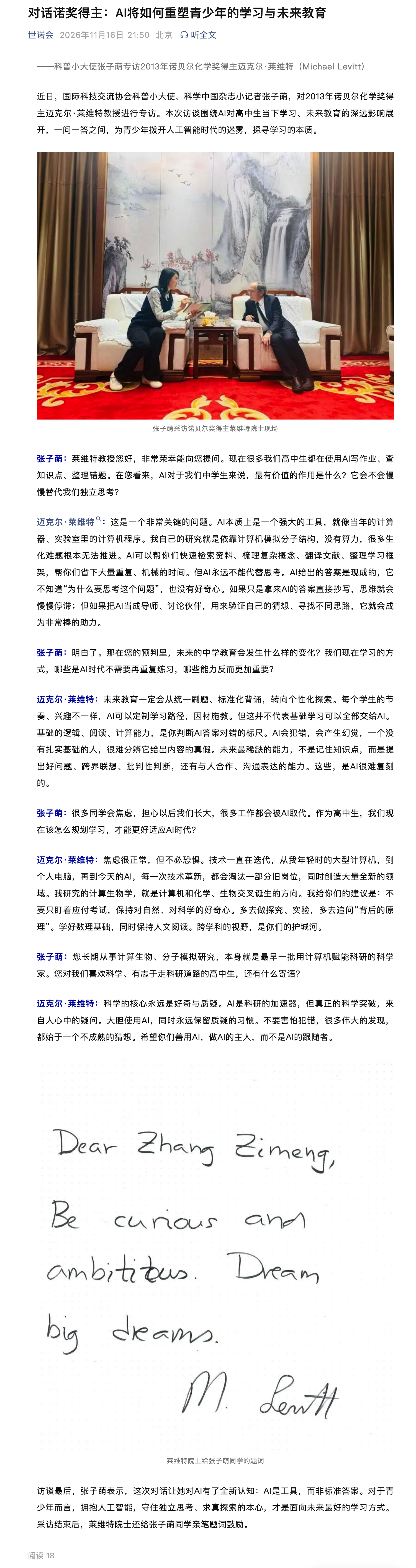
Zimeng Zhang interviews Michael Levitt, recipient of the 2013 Nobel Prize in Chemistry.
Original article published by 世诺会 on WeChat · November 16, 2026
Read the Chinese original ↗View saved article ↗
English translation of the published Chinese questions, answers, and closing remarks. The wording below is translated from the article, not an original English transcript.

Learning with AI without losing independent thought
Zimeng ZhangProfessor Levitt, it is an honor to speak with you. Many high school students now use AI for homework, looking up concepts, and organizing questions they got wrong. What do you think is AI’s most valuable role for students like us? Could it gradually replace our ability to think independently?
Michael LevittThat is a very important question. AI is fundamentally a powerful tool, much like calculators or computer programs in a laboratory. My own research relies on computers to simulate molecular structures. Without computing power, many problems in biochemistry would be impossible to tackle.
AI can help you find information quickly, make sense of complex concepts, translate research papers, and organize what you are learning. It can save you a great deal of time on repetitive, mechanical tasks. But AI can never replace thinking. Its answers are ready-made: it does not know why a question is worth thinking about, and it has no curiosity.
If you simply copy its answers, your thinking will gradually stagnate. But if you treat AI as a tutor or a partner in discussion, using it to test your ideas and explore different approaches, it can be a wonderful aid.
What students will still need to learn
Zimeng ZhangI see. What changes do you expect in secondary education? Which parts of how we study today will no longer need so much repetition in the AI era, and which abilities will become even more important?
Michael LevittEducation will move from the same drills and standardized memorization for everyone toward individual exploration. Students have different interests and learn at different paces. AI can tailor learning paths to their needs.
But this does not mean we can hand all foundational learning over to AI. Basic skills in logic, reading, and mathematics are what allow you to judge whether an AI answer is correct. AI makes mistakes and can hallucinate. Without a solid foundation, it is difficult to tell whether what it produces is true.
The abilities most in demand will not be memorizing facts, but asking good questions, making connections across fields, exercising critical judgment, and collaborating and communicating with others. These are difficult for AI to replicate.
Preparing for a changing world
Zimeng ZhangMany students feel anxious that AI will replace a lot of jobs by the time we grow up. As high school students, how should we plan our learning now to prepare for the AI era?
Michael LevittIt is natural to feel anxious, but there is no need to be afraid. Technology has always evolved, from the large computers of my youth to personal computers and now AI. Each technological advance eliminates some old jobs while creating many new fields. Computational biology, my own field, emerged from the intersection of computing, chemistry, and biology.
My advice is not to focus only on passing exams. Stay curious about nature and science. Investigate, experiment, and keep asking about the principles behind things. Build a strong foundation in mathematics and science while continuing to read in the humanities. A perspective that spans disciplines will serve you well.
Advice for aspiring scientists
Zimeng ZhangYou have spent many years working in computational biology and molecular simulation, and you were among the early scientists to use computers to advance research. What advice would you give high school students who love science and hope to pursue research?
Michael LevittCuriosity and questioning will always be at the heart of science. AI can accelerate research, but real scientific breakthroughs come from the questions people ask. Use AI boldly, but never lose the habit of questioning. Do not be afraid of making mistakes: many great discoveries begin with an idea that is not yet fully formed. I hope you will use AI well, directing it rather than following it.
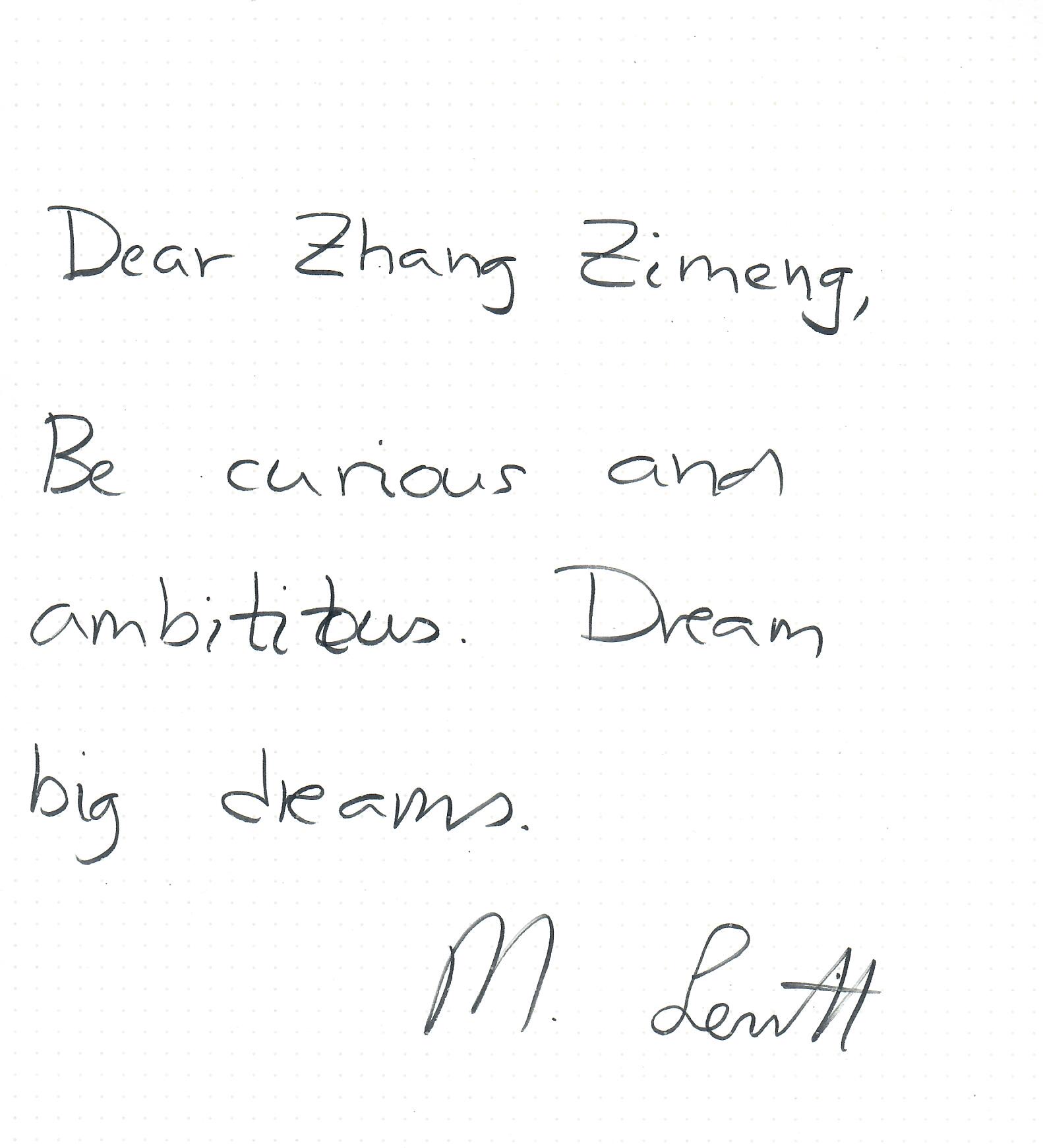
At the end of the interview, Zimeng said the conversation had given her a new understanding of AI: it is a tool, not a definitive answer. For young people, embracing AI while preserving independent thought and a commitment to inquiry is the best way to learn for the future. After the interview, Professor Levitt also wrote her a personal message of encouragement.